Dental Implants
Dental Implant Services
Need Dental Implants?
Contact With Us
Consult Dr. Snehal Vachheta Kotak for personalized dental treatment planning and restorative care.
+91 95587 73223
Dental Implants
Replace Missing Teeth with Confidence
Dental implants are a restorative option for replacing missing teeth. They can be used to support individual crowns, bridges, or selected denture solutions depending on the patient's dental condition and treatment requirements.
Implant treatment involves careful assessment and treatment planning to determine whether implants are appropriate and which restorative option best suits the individual situation.
The treatment plan considers the condition of the mouth, available supporting structures, the number and location of missing teeth, functional requirements, aesthetic considerations, and long-term restorative needs.
Dental Implant Placement
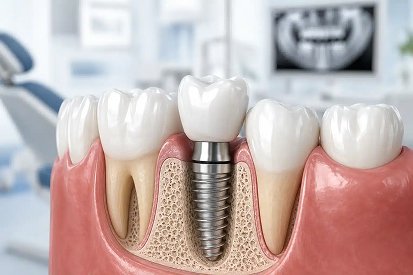
Dental implant placement involves positioning an implant within the jawbone to provide support for a future dental restoration.
Implant placement requires proper assessment and planning before treatment. The condition of the jawbone, gums, adjacent teeth, bite, and overall oral health may need to be evaluated.
Once the implant has been placed and the appropriate healing process has taken place, it may be restored with a suitable crown, bridge, or denture depending on the treatment plan.
Implant placement may be considered when:
- A tooth is missing
- A stable tooth replacement is required
- Suitable conditions are present for implant treatment
- An implant-supported restoration is being considered
Single-Tooth Implants
A single-tooth implant can be used to replace one missing tooth without relying on neighbouring teeth for support in the same way as a conventional bridge.
The implant acts as the foundation for an individual replacement tooth, which is usually restored with an implant-supported crown.
Careful planning is important to achieve an appropriate position, function, and appearance of the replacement tooth.
Single-tooth implants may be considered for:
- Replacement of a single missing tooth
- Selected cases where adjacent teeth are healthy
- Restoration of chewing function
- Replacement of a visible missing tooth
Multiple Dental Implants
Multiple dental implants may be used when several teeth are missing and implant-supported restorations are being considered.
Depending on the number and location of missing teeth, implants may support individual crowns, a bridge, or another appropriate restorative solution.
Treatment planning is individualized according to the distribution of missing teeth, available supporting structures, bite, and functional and aesthetic requirements.
Multiple implants may be considered when:
- Multiple teeth are missing
- Several missing teeth require replacement
- Implant-supported restorations are appropriate
- A planned restorative solution requires multiple implants
Implant-Supported Crowns & Bridges
Dental implants can be used to support crowns or bridges designed to replace missing teeth.
An implant-supported crown can replace an individual missing tooth, while implant-supported bridges may be used in selected cases where multiple teeth need replacement.
The final restoration is planned according to the implant position, available space, bite, aesthetics, and functional requirements.
Implant-supported crowns and bridges may help with:
- Replacement of missing teeth
- Restoration of chewing function
- Replacement of selected multiple missing teeth
- Restoration of the appearance of the smile
Implant-Supported Dentures
Implant-supported dentures use dental implants to provide support for a removable or appropriately designed denture solution.
Depending on the individual treatment plan, implants may help provide additional support and retention compared with a conventional denture.
The number of implants and the type of denture attachment depend on the patient's dental condition, treatment requirements, and restorative plan.
Implant-supported dentures may be considered when:
- Multiple or complete tooth loss is present
- Additional denture support is desired
- Implant treatment is clinically appropriate
- A supported denture solution is being planned
Implant Consultation & Treatment Planning
A detailed consultation is an important part of dental implant treatment. The aim is to understand the condition of the teeth, gums, jawbone, bite, and overall oral health before deciding on the appropriate treatment.
Treatment planning may include clinical examination and appropriate diagnostic evaluation to assess the proposed implant site and determine the most suitable restorative approach.
The treatment plan is discussed according to the number of missing teeth, available supporting structures, functional requirements, aesthetic goals, and the patient's individual circumstances.
Implant consultation may include evaluation of:
- Missing tooth or teeth
- Gum and periodontal condition
- Available supporting bone
- Adjacent teeth and surrounding structures
- Bite and functional requirements
- Aesthetic and restorative requirements
A Planned Approach to Dental Implant Treatment
Dental implant treatment should be planned according to the individual patient's dental condition rather than following the same approach for every case.
Dr. Snehal Vachheta Kotak focuses on careful assessment and personalized treatment planning, considering function, aesthetics, existing teeth, oral health, and the long-term restorative requirements.
Treatment planning considers:
- Number and location of missing teeth
- Condition of the gums and surrounding tissues
- Available supporting bone
- Existing teeth and restorations
- Bite and chewing requirements
- Aesthetic considerations
- Long-term maintenance and restorative needs
When to Consider Dental Implants
Dental implants may be considered as one of the options for replacing missing teeth. The suitability of implant treatment depends on the individual's oral health, available supporting structures, treatment requirements, and overall treatment plan.
A consultation is important before deciding whether an implant, bridge, denture, or another restorative option is appropriate.
You may benefit from an implant consultation if you have:
- One missing tooth
- Multiple missing teeth
- Difficulty with an existing tooth replacement
- A missing tooth affecting chewing function
- A missing tooth affecting smile aesthetics
- Interest in implant-supported restorative options
A dental implant is a restorative foundation placed within the jawbone to support a replacement tooth or other implant-supported restoration.
Yes. A single-tooth implant can be used in selected cases to support a replacement crown for one missing tooth.
Yes. Multiple implants may be used to support individual crowns, bridges, or other appropriate restorative solutions depending on the number and location of missing teeth.
Implant-supported crowns and bridges are restorations supported by dental implants and used to replace selected missing teeth.
Implant-supported dentures use dental implants to provide support for a denture. They may be considered in selected cases involving multiple or complete tooth loss.
Implant suitability varies from person to person. The condition of the gums, supporting bone, remaining teeth, oral health, and overall treatment requirements need to be assessed before treatment.
The consultation involves evaluating the missing tooth or teeth, gums, surrounding structures, available supporting bone, bite, and restorative requirements. Appropriate diagnostic evaluation may also be recommended as part of treatment planning.
In selected cases, an implant-supported restoration can be used instead of a conventional tooth-supported bridge. The appropriate option depends on the individual clinical situation and treatment plan.
Good oral hygiene and regular dental maintenance are important for maintaining the health of the tissues around an implant and the supporting teeth and gums.
A clinical consultation is required to determine whether implants are an appropriate option. The evaluation considers the missing teeth, oral health, gums, supporting structures, bite, aesthetic needs, and overall restorative treatment plan.